Solving Citation Management Issues in Arabic Law
Legal professionals in the GCC face tough challenges managing citations, especially in Arabic law. Navigating bilingual legal systems, inconsistent terminology, and jurisdiction-specific standards can complicate research and compliance. Here's what makes it difficult and how solutions like Laiwyer can help:
- Bilingual Complexity: Legal terms often differ between Arabic and English, requiring precise translations. Misinterpretations can lead to errors in legal documents.
- Jurisdiction-Specific Standards: Each GCC country has unique citation formats, making cross-border legal work harder.
- Outdated Resources: Many bilingual legal dictionaries are outdated and lack digital access, creating inefficiencies.
- Technical Barriers: Scanned documents and poor OCR tools hinder citation accuracy, especially for older legal texts.
AI tools like Laiwyer simplify this process. They offer automated citation generation, cross-jurisdiction search, and real-time updates to ensure accuracy and save time. Whether you're dealing with UAE, KSA, Qatar, or Egypt's legal systems, these tools streamline research and citation management. By combining AI efficiency with human expertise, GCC legal professionals can maintain precision and compliance in their work.
Citation Management Challenges in GCC Jurisdictions
Bilingual Citation Complexities
Managing citations in GCC jurisdictions often runs into complications due to the linguistic divide between Arabic and English. Arabic, with its distinct lexical and syntactic structure, doesn't always align neatly with Indo-European languages, leading to inconsistencies in translating legal terms. But the challenges go beyond simple translation - there are fundamental differences in how legal terms are used and understood.
For example, a single English legal term may have multiple, context-specific Arabic equivalents. These variations depend on the judicial procedure or the specific branch of law being referenced. Unfortunately, general bilingual dictionaries often fall short, offering only common language translations rather than precise legal terminology. The issue becomes even trickier when dealing with Sharia-influenced terms. Concepts like "assignment of receivables" require careful handling, as interpretations can differ across the four schools of Islamic thought.
"The meaning of a legal concept therefore goes beyond what an ordinary bilingual dictionary can tell us." – International Journal for the Semiotics of Law
Adding to the complexity, many bilingual legal dictionaries in the region remain outdated and are often only available in print. This lack of updated, digitised resources makes it difficult to integrate them into modern legal systems. Moreover, these older dictionaries typically lack the detailed knowledge needed to differentiate between the legal systems of various GCC countries. These linguistic hurdles set the groundwork for broader, jurisdiction-specific citation challenges.
Jurisdiction-Specific Citation Requirements
Apart from language-related issues, each GCC country has its own distinct citation standards, making legal research even more challenging. The region lacks a unified approach, and this fragmented system complicates the process. For instance, international UN conventions use the term Ihalat al Mustahaqaat (إحالة المستحقات) for "assignment of receivables", while national GCC laws often prefer Hawalat al Haq (حوالة الحق). This discrepancy highlights how terminology can vary widely, even within the same legal context.
Legal drafting differences further add to the complexity. Take the Constitution of Morocco as an example - it uses the term "فصل" (Fasl) to refer to an article, whereas other jurisdictions in the region favour "المادة" (Al-Madda). Such variations create significant challenges when trying to automate citation processes or conduct cross-jurisdictional legal research. The absence of a standardised citation system has even led some countries, like Oman, to develop their own frameworks, such as the Oman Legal Citation Standard (OLCS), to bring consistency to legal and academic work.
Technical barriers only make matters worse. Many official legal documents in the GCC are stored as scanned images or old typewritten pages in their respective Official Gazettes. Standard Optical Character Recognition (OCR) tools often fail to process these documents accurately due to the complexity of Arabic script and encoding issues. This creates what some call the "PDF bottleneck", where older primary sources become difficult to cite or verify. Legal professionals are then forced to spend extra time manually checking these citations, adding to the already significant workload.
sbb-itb-72d7a62
Manual Citation Management Methods
Using Official Legal Resources
Legal professionals across the GCC often rely on manual methods to maintain citation accuracy. A key resource is official government portals, such as the UAE Ministry of Justice's "e-Laws" portal. This platform provides access to primary legislation and verified citation details, ensuring that legal references are accurate and reliable. These portals supply authoritative versions of laws, complete with essential details like Official Gazette references - critical for proper citation.
For example, a correct UAE legal citation would include the Decree-Law number, Gregorian and Hijri dates, law title, and the Official Gazette reference. A typical citation might look like this: Federal Decree-Law No. 42, 03/10/2022 [7 Rabi' Al-Awwal 1444 H], Official Gazette Issue No. 737, page 157.
Legal professionals must also confirm the current validity of the law by checking for any amendments or repeals. For more specialised research, resources like Al Manhal, which focuses on scholarly Middle Eastern publications, and the GCC Statistical Centre, which provides regional data, are frequently consulted for additional context and accuracy.
These manual processes demand meticulous bilingual verification to ensure the highest level of legal precision.
Bilingual Verification Protocols
Bilingual verification is a critical step in ensuring that citations remain accurate across both Arabic and English texts. This process builds on the use of official resources and is particularly important in the UAE's multilingual legal environment.
In cases where a defendant's official language is not Arabic, legal notices must include a certified English translation.
"Arabic shall be the language used in courts... [however] the president of the local judiciary... may decide in some circuits... that the language of the trial, procedures, judgments, and decisions therein is English." – UAE Federal Decree Law No. 42
This verification process involves ensuring conceptual equivalence between the English translation and the original Arabic text. Legal professionals must carefully cross-reference English citations with the Arabic source material, applying terminology that is specific to the legal context. Additionally, citations must be verified at the article level to maintain the integrity of the legal context.
It is also crucial to distinguish between international legal terminology and UAE-specific terms. Misinterpretations can lead to what researchers describe as "unstable and dubious" concordances, which undermine the reliability of legal documents. Rigorous attention to detail in bilingual verification helps avoid such pitfalls and ensures consistency in legal practice.
AI-Powered Solutions with Laiwyer
Automated Citation Generators
Managing bilingual and jurisdiction-specific citations can be a daunting task, but Laiwyer simplifies this with its AI-powered solutions. Trained on thousands of regional legal documents and rulings, the platform ensures accurate bilingual citation generation, eliminating the need for manual checks across official portals and dictionaries.
With access to over 500,000 cited cases and laws from Qatar, the UAE, KSA, and Egypt, Laiwyer allows users to filter by jurisdiction, court level, and topic, ensuring compliance with local legal standards. Plus, it provides direct access to referenced case laws and statutes, so professionals can verify sources before incorporating them into legal documents.
"Whether you are researching local legislation, court rulings, or writing bilingual briefs, Laiwyer ensures you get accurate, culturally and legally relevant answers in your preferred language." – Laiwyer.ai
This level of precision is further enhanced by Laiwyer's cross-jurisdiction search capabilities, streamlining legal research even more.
Cross-Jurisdiction Search and Real-Time Updates
Laiwyer's cross-jurisdiction search is a game-changer for regional legal professionals. It allows users to compare how different GCC courts interpret similar statutes, a feature especially useful in commercial disputes. The platform maintains jurisdiction-specific accuracy while enabling users to narrow searches by court level, ensuring that cited precedents are relevant and applicable to each case.
Real-time updates ensure that citations remain current, removing the need for manual checks as regulations and precedents evolve. To help legal professionals explore its full potential, Laiwyer offers a 14-day free trial of its research and citation tools.
Secure Data Handling
Legal research often involves sensitive information, and Laiwyer takes data security seriously. By employing encryption and advanced security protocols, the platform ensures all queries and documents remain private and protected from unauthorised access. Additionally, the system is fully auditable, meeting the standards required by judicial bodies and regulators.
"Laiwyer uses enterprise-grade security protocols to ensure your data stays private and protected. All queries and documents are encrypted and confidential." – Laiwyer
This robust security framework aligns with the DIFC Courts' focus on client confidentiality when using AI tools. It also supports compliance with the Data Protection Law 2020, maintaining the high standards necessary for handling sensitive legal information.
Adding Laiwyer to GCC Legal Workflows
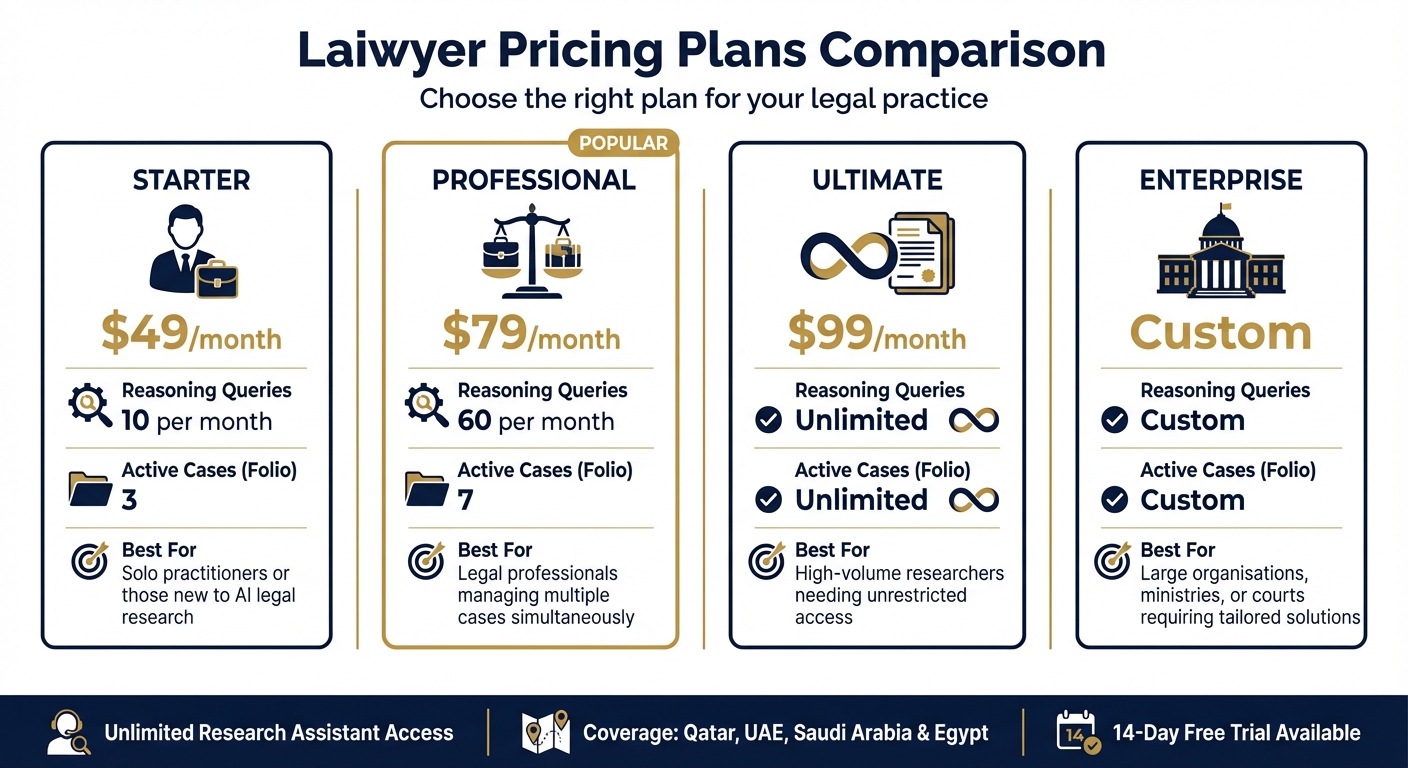
Laiwyer Pricing Plans for GCC Legal Professionals
Steps for Implementation
Start by selecting your jurisdiction - Qatar, KSA, UAE, or Egypt - to ensure your research aligns with the local legal framework. Laiwyer supports bilingual queries in both Arabic and English, recognising regional legal terminology. Narrow your search results by filtering by topic or court level, and then copy citations directly into your legal documents for streamlined preparation.
Use the Folio feature to organise case-specific research and citations. This tool makes it easier to manage and retrieve information for ongoing cases. Additionally, the Chat with Files function allows you to upload legal documents and extract relevant insights or citations effortlessly. These features integrate seamlessly with Laiwyer's AI-powered research capabilities, ensuring your workflow remains consistent across languages and jurisdictions.
"Parties should not rely on AI-generated content without first verifying its accuracy. This should be done through using independent sources such as case law, statutes and credible legal commentary." – DIFC Courts, Practical Guidance Note No. 2 of 2023
It's essential to cross-check AI-generated citations against official legal sources. If you plan to use AI-generated content in court proceedings, disclose this at the earliest possible stage - preferably during the Case Management Conference - to uphold transparency and professional integrity.
Once your workflow is established, you can explore Laiwyer's pricing plans to find the option that best suits your practice.
Laiwyer Pricing Plans Comparison
Selecting the right plan depends on your workload and research needs. Here’s a breakdown of the available options:
| Plan | Price (USD/month) | Reasoning Queries | Active Cases (Folio) | Best For |
|---|---|---|---|---|
| Starter | $49 | 10 per month | 3 | Solo practitioners or those new to AI legal research |
| Professional | $79 | 60 per month | 7 | Legal professionals managing multiple cases simultaneously |
| Ultimate | $99 | Unlimited | Unlimited | High-volume researchers needing unrestricted access |
| Enterprise | Custom | Custom | Custom | Large organisations, ministries, or courts requiring tailored solutions |
All plans include unlimited access to the research assistant and cover jurisdictions in Qatar, UAE, Saudi Arabia, and Egypt. Higher-tier plans unlock advanced features for handling complex reasoning queries, while the Enterprise option is designed for institutions with specific requirements. Laiwyer also offers a 14-day free trial, giving you the opportunity to test its jurisdiction-specific capabilities before committing to a subscription.
Conclusion
Benefits of Using Laiwyer
Laiwyer offers a practical solution to one of the most time-consuming tasks in the legal profession: managing citations across both Arabic and English legal systems. By addressing bilingual terminology accuracy, jurisdiction-specific filtering, and real-time legal updates, it tackles the daily challenges faced by GCC legal professionals. Whether you're verifying laws or court rulings in the UAE, Qatar, Saudi Arabia, or Egypt, Laiwyer ensures precision and consistency.
Its bilingual capabilities maintain the formal integrity of legal terms in both languages, which is crucial for cross-jurisdictional work. Additionally, its jurisdiction-specific filters help ensure your citations fit the relevant legal framework. These features not only improve efficiency but also pave the way for smoother workflows in the future.
The Future of Legal Research in GCC Countries
Looking ahead, the integration of AI into legal research promises to reshape the field. In a region where bilingual legal systems and unique citation standards add complexity, this evolution is particularly necessary. The legal sector is moving towards a hybrid model: AI handles foundational research tasks, while lawyers focus on strategic and analytical aspects. This is especially important for Arabic law, which has historically lacked robust bilingual legal resources, despite Arabic being one of the most widely spoken languages online.
"A move towards formalising legal knowledge will help fill existing gaps in the representation of Arabic legal content and the retrieval of information." – International Journal for the Semiotics of Law
As AI tools continue to improve, platforms tailored to GCC legal systems will become indispensable. They will help legal professionals maintain accuracy, save time, and ensure compliance. The future belongs to those who can combine AI's efficiency with their own legal expertise to deliver nuanced case analysis and client strategies. With Laiwyer's 14-day free trial, you can explore these features firsthand and see how AI-powered citation management can transform your practice.
FAQs
How does Laiwyer simplify bilingual citation management in Arabic law?
Laiwyer makes managing bilingual citations in Arabic law much easier by using AI-driven tools that are fluent in both Arabic and English legal terms. This ensures citations are formatted accurately to align with the specific standards of GCC jurisdictions, including the UAE.
With tools like automated citation generators and bilingual formatting options, Laiwyer simplifies legal research. It helps professionals save time while ensuring precision in both languages, catering to the distinct requirements of Arabic and English legal frameworks.
What are the key challenges in managing legal citations across GCC jurisdictions?
Managing legal citations across GCC jurisdictions can be quite challenging due to the variety of legal systems and citation practices in the region. Each GCC country - be it the UAE, Saudi Arabia, Oman, Qatar, Bahrain, or Kuwait - operates under its own legal framework, which includes distinct citation conventions. For instance, Oman might have detailed citation guidelines, while other nations could lean on more general regional or international practices. This lack of uniformity often results in inconsistencies.
Adding to the complexity are differences in legal terminology, enforcement methods, and the bilingual nature of legal documentation (Arabic and English). Legal professionals must navigate these variations to cite laws, decrees, and case law accurately, which becomes especially tricky when conducting cross-border legal research. With AI tools increasingly being used for legal research, there’s a growing demand for adaptable citation standards that can address the specific needs of this diverse region.
How does Laiwyer protect data security and confidentiality during legal research?
Laiwyer places a strong emphasis on data security and confidentiality, using advanced methods designed specifically for handling sensitive legal research. Your data is stored on private servers located within your jurisdiction, ensuring it complies with local regulations and maintains data sovereignty. This means your information never leaves your secure environment.
To further enhance protection, Laiwyer avoids relying on public cloud AI APIs. This eliminates the risk of unauthorised access or accidental data exposure. The platform also follows international data protection standards, such as GDPR, the UK DPA, and relevant US state laws, offering an additional layer of security. By providing full transparency and granting users control over AI operations, Laiwyer ensures your data stays protected and confidential at all times.