Laiwyer vs. ChatGPT: Which One Is Better for Legal Research in MENA?
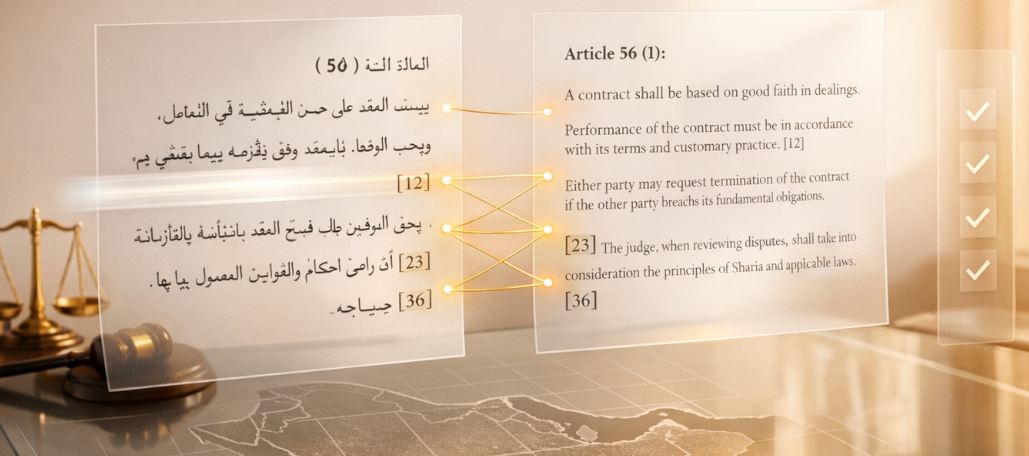
Legal professionals across the Middle East are using AI more than ever. Many start with ChatGPT - a powerful general-purpose tool that can draft emails, summarize text, and generate ideas. But when it comes to legal research in Qatar, UAE, Saudi Arabia, Egypt, and other MENA jurisdictions, the difference between ChatGPT and Laiwyer is significant.
Below is a clear comparison designed to help practitioners, firms, ministries, and in-house teams understand which tool best supports real legal work.
1. General AI vs. Legal AI Built for MENA
ChatGPT
- Built for general conversation and broad knowledge
- Not aligned with GCC legal frameworks
- Generates answers based on patterns, not legal sources
- Output must always be manually verified
Laiwyer
- Purpose-built for legal research in the Middle East
- Works with official laws, court rulings, and ministerial decisions
- Designed for lawyers, judges, ministries, and law students
- Provides reliable bilingual answers backed by real sources
Bottom line:
ChatGPT is impressive, but it’s not a legal research tool. Laiwyer is designed specifically for this region’s legal systems.
2. Accuracy and Hallucinations
One of the biggest concerns in legal practice is accuracy. It’s not enough for an AI tool to “sound correct” - it must be provably correct, especially in court.
ChatGPT:
- Can fabricate articles of law
- May produce incorrect or non-existent case citations
- Requires extensive user verification
- Not grounded in official legal documents
Laiwyer:
- Answers are derived directly from official legal sources
- Citations reference real statutes, rulings, and regulatory decisions
- Risk of fabrications or hallucinations minimized as everything can be verified through the original legal documents provided by the plaform
- Built for professional use where accuracy is non-negotiable
Bottom line:
Where accuracy matters, Laiwyer provides verifiable legal answers you can rely on.
3. Arabic and English Legal Understanding
Legal research in MENA often requires navigating Arabic texts, bilingual drafting, and cross-language interpretation.
ChatGPT:
- Functions in Arabic, but struggles with legal nuances
- Not aligned with GCC legal terminology
- May misinterpret critical legal phrasing
Laiwyer:
- Natively understands both Arabic and English legal text
- Handles mixed-language queries common in legal practice
- Interprets statutes and decisions with regional accuracy
Bottom line:
For Arabic-first legal systems, specialized AI makes all the difference.
4. Jurisdiction-Specific Insights
A legal researcher needs answers within the correct jurisdiction.
This is where general-purpose AI struggles the most.
ChatGPT:
- Provides general, non-jurisdictional information
- May mix international, US, or irrelevant legal concepts
- Cannot reliably differentiate Middle Eastern legal frameworks
Laiwyer:
- Tailored to Qatar, UAE, Saudi Arabia, and Egypt
- Produces answers specific to the user's country
- Expanding to additional Arab jurisdictions
- Built for real legal workflows in the region
Bottom line:
Laiwyer understands the legal landscape of the Arab world. ChatGPT does not.
5. Confidentiality and Data Privacy
For law firms, government entities, and corporate legal teams, confidentiality is essential.
ChatGPT:
- User input may be processed externally depending on settings
- Not purpose-built for legal confidentiality
- Potential risk when handling sensitive or privileged information
Laiwyer:
- Privacy-by-design architecture
- Queries are encrypted and never stored for model training
- Compliant with legal ethics and confidentiality standards
- Designed for sensitive government and corporate environments
Bottom line:
Legal research should never risk exposing confidential information.
6. Workflow Efficiency
Legal teams need answers fast and with minimal prompting.
ChatGPT:
- Great for ideation or drafting
- Requires back-and-forth refinement
- Not optimized for structured legal answers
Laiwyer:
- Instant, structured legal responses
- Reduces research time by up to 80%
- Designed to integrate into real legal work, not just chat-based exploration
Bottom line:
ChatGPT helps with general tasks; Laiwyer accelerates legal research directly.
Final Verdict: Use Each Tool for What It Was Designed For
Both platforms are powerful, but they serve different purposes:
ChatGPT is ideal for:
- Drafting general text
- Brainstorming
- Summaries
- Administrative or non-legal tasks
Laiwyer is ideal for:
- Legal research
- Statutory interpretation
- Case law analysis
- Ministry and regulatory questions
- Arabic-English legal work
- Court preparation
- Government or corporate legal workflows
For legal professionals in MENA, Laiwyer offers accuracy, jurisdiction specificity, and confidentiality that general-purpose AI cannot provide.
As the region embraces digital transformation and AI adoption, the distinction becomes even clearer:
ChatGPT is a versatile assistant. Laiwyer is a legal research engine built and specialized for legal professionals in the Arab world.