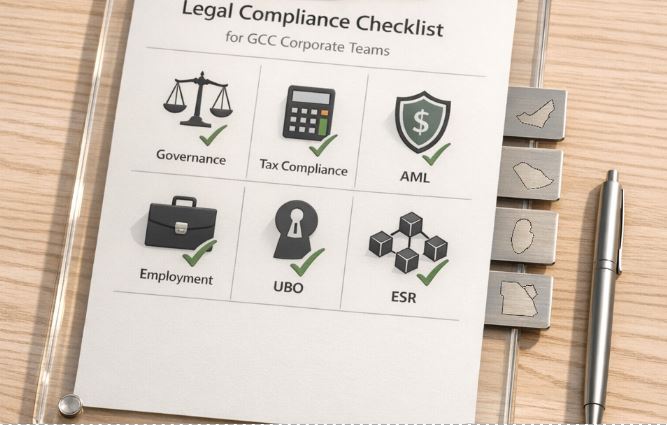
Legal Compliance Checklist for GCC Corporate Teams
Managing legal compliance across the GCC is complex. Each country - UAE, Qatar, Saudi Arabia, and Egypt - has its own laws, tax systems, and labour frameworks. Non-compliance can lead to severe penalties, such as fines reaching AED 10 million for governance violations or AED 5 million for AML breaches. Here's what you need to know:
- Key Challenges: Four distinct legal systems, bilingual legal requirements (Arabic prevails), and varying regulatory updates like UAE's 9% corporate tax or KSA's 15% VAT.
- High-Risk Areas: AML compliance, VAT filings, Economic Substance Regulations, and Emiratisation quotas.
- Deadlines: Update statutory records (e.g., UBO Register) within 15 days of changes; retain accounting records for 5 years; file tax returns within 9 months of the tax period.
- Employee Compliance: Mandatory bilingual contracts, WPS registration, and adherence to labour laws like fixed-term contracts and Emiratisation.
Solution: Tools like Laiwyer simplify compliance management with bilingual legal updates, cross-jurisdictional analysis, and deadline tracking. Staying compliant requires structured reviews, clear documentation, and meeting submission deadlines to avoid penalties.

Corporate Governance Compliance Checklist
Corporate governance in the GCC is shaped by jurisdiction-specific regulations, with the UAE providing clear guidelines through Federal Decree-Law No. 32 of 2021 for Limited Liability Companies and Resolution No. 3/RM of 2020 for Public Joint Stock Companies. Each type of company has distinct obligations that can be tracked and monitored.
Board Composition and Director Duties
The UAE has removed nationality restrictions for board members under Decree Law No. 20 of 2025, allowing foreign nationals to hold board positions. This move aligns with the region's broader competitiveness goals [4]. Public Joint Stock Companies must follow strict board formation and election rules set by the Securities and Commodities Authority, while Limited Liability Companies are managed by directors appointed by the owner [2].
Directors across all company types are required to act with the care of a "prudent person", maintain honesty, and prioritise the company's interests [2]. They must disclose any conflicts of interest and abstain from voting on related matters, with companies maintaining an updated related-party register [8]. Nominee board members are obligated to notify the company within 15 days and provide necessary details [9].
For financial institutions, the Central Bank of the UAE enforces tougher standards, including mandatory written policies on conflicts of interest. Board meetings must be formalised, with minutes documenting all decisions - along with dissenting opinions or reservations - and signed by all attendees to reduce liability risks [2].
In addition to fulfilling board responsibilities, companies must ensure statutory records are consistently updated.
Statutory Records and UBO Register Updates
Effective governance requires companies to keep statutory records up to date. In the UAE, all legal entities (except those in financial free zones or government-owned entities) must maintain a Beneficial Owner's Record and a Register of Partners or Shareholders [9]. A Beneficial Owner is defined as an individual who directly or indirectly owns or controls 25% or more of the company's capital or voting rights [9]. If no one meets this threshold, the individual in a higher management role is considered the Beneficial Owner.
Record Type
Mandatory Contents
Update Deadline
Beneficial Owner's Record
Full name, nationality, birth details, residential address, ID/passport info, basis of ownership
Within 15 days of change [9]
Register of Partners/Shareholders
Share count, categories, voting rights, acquisition dates, ID/passport copies
Within 15 days of change [9]
General Company Details
Name, address, share capital, legal form, management data
Within 15 business days of change [2][6]
Accounting Records
Transactions, balance sheets, profit/loss accounts
Initial UBO and Partner/Shareholder data must be submitted to the Registrar within 60 days of licensing or registration [9]. Companies are also required to appoint a natural person residing in the UAE as a compliance liaison, authorised to provide the Registrar with necessary information [9]. All records must be retained for at least five years after the company is cancelled, dissolved, or liquidated [9].
Internal Controls for Transparency
Boards are responsible for implementing strong internal audits to safeguard administrative, financial, and accounting systems [10]. This includes identifying risks, defining measurable risk thresholds [10], and establishing systems to manage those risks effectively [10].
A disclosure policy is also essential, enabling shareholders to access financial and non-financial information, such as equity ownership details and any material facts that could influence security prices or investor decisions [10]. For Public Joint Stock Companies, boards are encouraged to create specialised committees - such as Audit, Risk, and Remuneration Committees - to oversee governance functions [10].
Failure to comply with governance regulations can result in fines of up to AED 10 million, imposed by the Ministry of Economy or the Securities and Commodities Authority [2][6].
Employment and Labour Compliance Checklist
The UAE’s Federal Decree-Law No. 33 of 2021 sets clear rules for employee documentation, wage payments, and workforce development. Failing to comply can result in fines of up to AED 20,000 [11]. Below is a breakdown of key legal obligations for employers.
Employee Documentation Requirements
Employment agreements in the UAE start with a bilingual job offer (Arabic and English), with an additional language added if necessary [11]. For professional-level employees (levels 1, 2, and 3), electronic signatures are required, while levels 4 and 5 may use fingerprints [11]. These offers must include an annex summarising UAE Labour Law provisions.
Employers must sign fixed-term employment contracts (up to three years, renewable) and submit them to the Ministry of Human Resources and Emiratisation (MoHRE) within 14 days of the employee’s arrival [11][13]. Before the employee enters the UAE, initial work permit approval is required, followed by the issuance of a work permit by MoHRE [11][14]. Employment records must be kept for at least two years after the employee leaves [14]. Additionally, experience certificates detailing job title, service dates, and final wage must be provided at no cost when the contract ends [14].
Document Type
Requirement Detail
Deadline/Duration
Job Offer
Bilingual (Arabic/English) + 3rd language
Before applying for a work permit
Employment Contract
Fixed-term (Limited)
Submit within 14 days of arrival
Work Permit
Issued by MoHRE
Valid for the contract duration
Worker File
Employment records
Retain for 2 years post-service
Experience Certificate
Job title, dates, and last wage
Provide upon request at termination
Wage Protection System (WPS) and Emiratisation
The Wage Protection System (WPS), developed by the UAE Central Bank and MoHRE, ensures that private-sector wages are paid electronically. Employers must pay salaries through approved banks, exchange houses, or financial institutions.
Salaries are due on the first day of the month following the contract period. Delays beyond 15 days can result in blocked work permits [17]. Employers must register new employees in the WPS within 60 days of signing their contracts [17] and submit payment details using the standard Salary Information File (SIF) format. Providing false wage data can lead to fines of AED 1,000 per employee [17]. Salary deductions are capped at 10% unless authorised by law [17].
Companies with 50 or more employees must meet Emiratisation quotas or face a monthly penalty of AED 9,000 per unfilled role by 2026 [17]. Employers are encouraged to register with the "Nafis" platform, which supports Emirati workforce participation [13]. UAE nationals benefit from pension contributions - 12.5% from employers and 5% from employees - and are subject to pension and social security laws instead of the gratuity system used for expatriates [12][15][16].
Staff Training and Reporting Procedures
Employers are required to establish documented training and skill development programmes as per Article 13 of the Labour Law [18]. These programmes should include written work organisation regulations detailing sanctions, promotions, and bonuses [14]. Payroll and HR systems must also accommodate national pension and social security contributions for Emirati employees [12][16].
Working hours are limited to 8 hours per day or 48 hours per week [12][14]. Probation periods cannot exceed six months, and at least 14 days’ written notice is required for termination during this time [14].
Tax and Financial Reporting Compliance Checklist
In addition to governance and employment mandates, businesses in the UAE must ensure strict compliance with tax and financial reporting obligations.
The UAE corporate tax framework requires all taxable persons - including Free Zone companies - to register with the Federal Tax Authority (FTA) and obtain a unique Corporate Tax Registration Number. This applies to UAE-incorporated companies, foreign legal entities operating in the UAE, non-resident entities with a UAE permanent establishment, and certain natural persons as outlined in Cabinet Decision [19].
Corporate Tax Registration and Deadlines
Registration is non-negotiable for all taxable persons, even if preferential rates apply. For instance, Free Zone entities enjoying a 0% tax rate on qualifying income must still meet registration requirements. Corporate Tax returns must be filed no later than nine months after the end of the tax period. Aligning your financial year with the tax period can simplify the process of converting accounting profits into taxable income [19]. Accurate registration also hinges on maintaining precise accounting practices, which are crucial for audits and reporting.
Audit and Financial Statement Preparation
Under the Federal Decree Law on Commercial Companies, UAE businesses are required to maintain accounting records that accurately reflect their financial activities and overall financial position [2]. Taxable income is calculated based on financial statements prepared according to International Financial Reporting Standards (IFRS).
- Public Joint Stock Companies must have their annual accounts audited by a licensed auditor.
- Other entities are required to undergo audits when annual revenue exceeds AED 50 million.
- Multinational enterprise groups with consolidated annual revenue over AED 3.15 billion must prepare Country-by-Country Reports within 12 months of the fiscal year-end [2][20].
Beyond audits, companies must ensure all related-party transactions are well-documented and compliant with established guidelines.
Related-Party Transaction Documentation
Transactions between related parties must adhere to the Arm's Length Principle, ensuring they are priced as if conducted between independent entities. For compliance, taxable persons must maintain detailed transfer pricing documentation, including a Master File and a Local File, to demonstrate that pricing aligns with market standards. Additionally, a disclosure form must be submitted along with the Tax Return. Payments to connected persons are deductible only if priced at market value.
Businesses must retain all supporting records for at least seven years after the relevant tax period. For companies involved in both exempt and taxable activities - such as extractive businesses - separate financial statements are recommended. Internal transfers in such cases should also be treated as related-party transactions [21].
AML, Data Protection, and Reporting Compliance Checklist
Meeting your tax and governance obligations isn’t just about ticking boxes - it’s about building a resilient corporate structure in the GCC. Adhering to AML, data protection, and economic substance regulations is crucial for businesses across the UAE, covering both mainland and free zones. Non-compliance can lead to serious penalties, so let’s break down what you need to know.
AML/CFT Policy Updates and Reporting
Anti-Money Laundering (AML) compliance in the UAE is regulated under Federal Decree-Law No. [undefined] of 2025. This law applies to financial institutions, Designated Non-Financial Businesses and Professions (DNFBPs), and Virtual Asset Service Providers (VASPs). A risk-based approach (RBA) is essential to identify and address potential money laundering or terrorism financing risks.
For transactions over AED 55,000 or wire transfers exceeding AED 3,500, businesses must perform customer due diligence and verify Ultimate Beneficial Owners (UBOs) using reliable, independent sources [23]. Certain practices are strictly prohibited, such as maintaining anonymous accounts, dealing in bearer shares, or working with shell banks [22].
When suspicious activity arises, submit a Suspicious Transaction Report (STR) through the FIU’s goAML platform [24]. Keep in mind that professional or banking secrecy cannot be used as an excuse to withhold reports. Importantly, staff must never inform customers about filed reports - this practice, known as "tipping off", carries severe legal consequences. The Chief of the FIU also holds the authority to freeze suspicious funds for up to 30 days without prior notice [24]. Penalties for non-compliance range from AED 50,000 to AED 5,000,000 [23].
Data Protection and Breach Reporting
The UAE’s Personal Data Protection Law (PDPL), established under Federal Decree Law No. 45 of 2021, governs the processing of personal data for individuals both within and outside the UAE. In cases of serious data breaches, businesses must notify the UAE Data Office and inform affected individuals if significant harm is likely [25]. Additionally, companies must respond to user requests for data access or deletion within 30 days [25].
If your business processes sensitive information or engages in large-scale behavioural profiling, appointing a Data Protection Officer (DPO) is mandatory [25]. Transparency is further reinforced by maintaining an updated UBO register. Violations of the PDPL can lead to administrative fines, suspension of business licences, or even lawsuits from affected individuals [25].
Economic Substance Compliance
Economic Substance Regulations (ESR) apply to UAE mainland and free zone entities conducting "Relevant Activities" such as banking, insurance, investment fund management, holding company operations, intellectual property business, and distribution centres [26]. To demonstrate economic substance, businesses must show local management, employ qualified staff, incur sufficient expenditures, and maintain physical assets in the UAE.
All entities under ESR must file an annual notification form with their regulatory authority within 12 months of the financial year’s end, regardless of whether they earned income or qualify for an exemption. Those earning income from Relevant Activities must also submit a detailed Economic Substance Report via the Ministry of Finance (MoF) ESR Portal [26]. Non-compliance can lead to administrative penalties, sharing of information with foreign tax authorities, and even suspension or revocation of trade licences. To prepare for audits, ensure you maintain evidence such as board meeting minutes, employee records, and lease agreements.
Using Laiwyer for Compliance Management

Laiwyer builds upon the foundation of compliance checklists by offering tools designed to simplify the complexities of managing regulatory obligations. In the GCC, navigating compliance means dealing with agencies like VARA, SCA, DFSA, ADGM FSRA, and CBUAE, each with its own set of rules [28]. Corporate teams must carefully identify which regulations apply based on their business type, location, and operations [27]. This is where Laiwyer’s AI-powered tools come into play, making compliance management much more straightforward.
Below are some of the standout features that make Laiwyer an essential tool for managing GCC compliance.
Key Features for GCC Compliance
Laiwyer’s dual-language search functionality, supporting both Arabic and English, is a game-changer. In the UAE, the Arabic version of legislation holds legal precedence over translations, so having access to both versions is critical to avoid costly misinterpretations [2][5]. The platform also delivers real-time legal updates across Qatar, UAE, KSA, and Egypt, ensuring your team stays informed about regulatory changes without manual tracking.
Another key feature is Laiwyer’s cross-jurisdiction analysis, which aligns evolving regulations with your internal compliance controls. This reduces redundancies and ensures consistent practices across GCC markets [27]. For instance, it connects Federal Decree-Law No. 20 of 2018 with the 2024–2027 National AML/CFT Strategy [29]. Additionally, the platform simplifies citation management, enabling easy referencing of specific legal provisions during audits or reviews.
Laiwyer also consolidates updates on corporate governance, economic substance, and reporting deadlines. It simplifies compliance with Economic Substance Regulations for "Relevant Activities" and UBO disclosure requirements [1][30]. The platform can even track deadlines for Corporate Tax (Decree-Law No. 47 of 2022), VAT filings, and Country-by-Country Reporting for multinational corporations with revenues exceeding AED 3.15 billion [30][31].
Pricing Plans for Corporate Teams
Laiwyer offers flexible subscription plans tailored to different compliance needs within the GCC.
- Starter Plan (AED 180/month): Perfect for small teams, this plan includes up to 10 reasoning queries and 3 active cases, covering Qatar, UAE, KSA, and Egypt.
- Professional Plan (AED 290/month): Ideal for mid-sized legal departments, it provides 60 reasoning queries and 7 active cases, making it suitable for regular compliance management.
- Ultimate Plan (AED 364/month): Designed for large teams operating across multiple jurisdictions, this plan offers unlimited reasoning queries and active cases.
- Enterprise Plan: For ministries, courts, or organisations with complex needs, this custom plan offers tailored features and pricing.
With these options, Laiwyer ensures that companies of all sizes can find a plan that supports their compliance efforts effectively.
Implementation Steps and Best Practices
To stay on top of compliance, conduct monthly internal reviews to track renewals and update statutory records, including the UBO register [3][5]. Keep a close eye on deadlines for business licence renewals, quarterly VAT returns, and annual audits. If there are changes to registered details - like the company name, address, share capital, or legal form - corporate teams must notify the Competent Authority and Registrar within 15 business days [5]. These reviews are essential for maintaining an effective compliance calendar.
Setting Up a Compliance Review Schedule
Create a structured schedule for recurring reviews and one-off notifications. Ensure accounting records are retained for at least five years [3][6]. The board of directors or company managers carry the legal responsibility for enforcing governance rules and standards, so it’s critical to clearly outline these roles within your organisation [6]. Additionally, establish clear reporting protocols for suspicious transactions under AML requirements and data breaches under PDPL [1][3].
Focusing on High-Risk Areas
High-risk areas need extra attention, especially where penalties are severe. For instance, violating corporate governance regulations could lead to fines of up to AED 10 million [6], while failing to meet Anti-Money Laundering (AML) requirements may result in penalties of up to AED 5 million [1]. To comply with AML obligations, register with the Financial Intelligence Unit's goAML platform to submit Suspicious Transaction Reports and Activity Reports [32]. Prioritise key compliance areas like AML, VAT filings, and Economic Substance filings to avoid significant fines. Non-compliance with Economic Substance Regulations could result in penalties of up to 300% of the unpaid tax [1].
Phased Approach to Compliance
A phased compliance strategy can help streamline your processes effectively. Break it down into three phases:
- Initial Setup: Verify business licences, register for Corporate Tax if your taxable turnover exceeds AED 375,000, and complete MOHRE registrations.
- Documentation: Prepare MOHRE-approved contracts, attest the Memorandum of Association in Arabic (since the Arabic version prevails in legal disputes), and establish AML policies.
- Submission: File VAT returns, submit UBO declarations, and ensure records are retained for five years [3][5][6][33].
Take advantage of transition periods provided by regulatory updates. For instance, the revised UAE tax penalty framework allows until 14 April 2026 to align internal processes with new regulations [33]. Use this time to review and refine your compliance strategies.
Conclusion
Staying compliant with GCC regulations requires constant attention. Businesses must retain statutory records for at least five years and register with goAML for anti-money laundering (AML) reporting purposes [3]. Failing to meet these obligations can result in harsh penalties, including licence revocation and other serious repercussions [1]. This reality highlights the importance of a strong, adaptable compliance strategy.
The UAE’s rapidly evolving legal landscape demands quick adjustments. For instance, recent changes to the Commercial Companies Law have removed nationality restrictions for board members and lifted limits on founder contributions [4][7]. As the UAE Ministry of Economy explained:
"The law aims to enhance the openness of the UAE's business climate in a way that supports the competitiveness of the national economy and the dynamism of the business environment." [4]
Proactive internal reviews and timely updates are essential, as outlined in our compliance checklists. A phased approach - focusing on initial setup, proper documentation, and meeting submission deadlines - ensures your organisation remains ahead of regulatory shifts.
To simplify this process, Laiwyer offers a streamlined solution for managing GCC compliance. With AI-powered legal tools designed for the region, Laiwyer provides real-time legal updates, cross-jurisdictional analysis for Qatar, UAE, KSA, and Egypt, bilingual resources, and secure case management. Whether it’s tracking VAT deadlines, staying on top of corporate governance updates, or managing ongoing regulatory needs, Laiwyer consolidates all your compliance efforts into one reliable platform.
FAQs
What are the consequences of failing to comply with GCC legal requirements?
Failing to meet legal requirements in GCC countries can result in serious repercussions, such as hefty fines, imprisonment, or even deportation. The penalties imposed depend on the type and seriousness of the violation. For example, in the UAE, breaches in corporate governance can lead to fines as high as AED 10,000,000, while penalties for commercial violations typically range between AED 50,000 and AED 200,000.
Staying informed about the specific laws in each jurisdiction is essential for businesses aiming to avoid these penalties and ensure smooth operations. Beyond avoiding legal trouble, compliance plays a key role in building trust and maintaining credibility in the marketplace.
What are the best practices for managing legal compliance across GCC countries?
To navigate legal compliance across GCC countries effectively, businesses need a clear grasp of each jurisdiction's unique regulations and should implement compliance strategies tailored to those requirements. For instance, in the UAE, compliance involves securing the appropriate licences, registering for VAT, and following labour laws. Staying informed on legislative updates, such as changes to commercial company laws, is equally important to avoid non-compliance.
Using integrated legal management systems can simplify the process by tracking country-specific regulations, deadlines, and reporting requirements. Regular legal audits and employee training are also key to ensuring continued compliance. Additionally, partnering with local legal experts can help identify and reduce risks. Aligning internal policies with both international standards and local regulations fosters a proactive approach to compliance, helping businesses avoid penalties and legal disputes.
What are the best ways to track legal updates and compliance deadlines in the GCC, especially in the UAE?
Keeping up with legal updates and compliance deadlines in the GCC, especially in the UAE, is essential for corporate teams. Fortunately, there are several resources and tools available to make this process more manageable:
- Legal Update Platforms: Tools like legal information portals and practice management systems offer regular updates on new laws, amendments, and upcoming compliance deadlines. These platforms are a reliable way to stay ahead of changes.
- Government Websites: Official platforms, such as the UAE Ministry of Economy, provide detailed insights into sector-specific regulations and legal obligations. These sites are a go-to source for accurate and up-to-date information.
- Compliance Checklists: Customised checklists tailored to specific jurisdictions can simplify the process of tracking legal requirements and help ensure that deadlines are consistently met.
By leveraging these tools, businesses can take a proactive approach to compliance, stay informed about regulatory changes, and ensure they meet all local legal requirements effectively.